 Getty Images
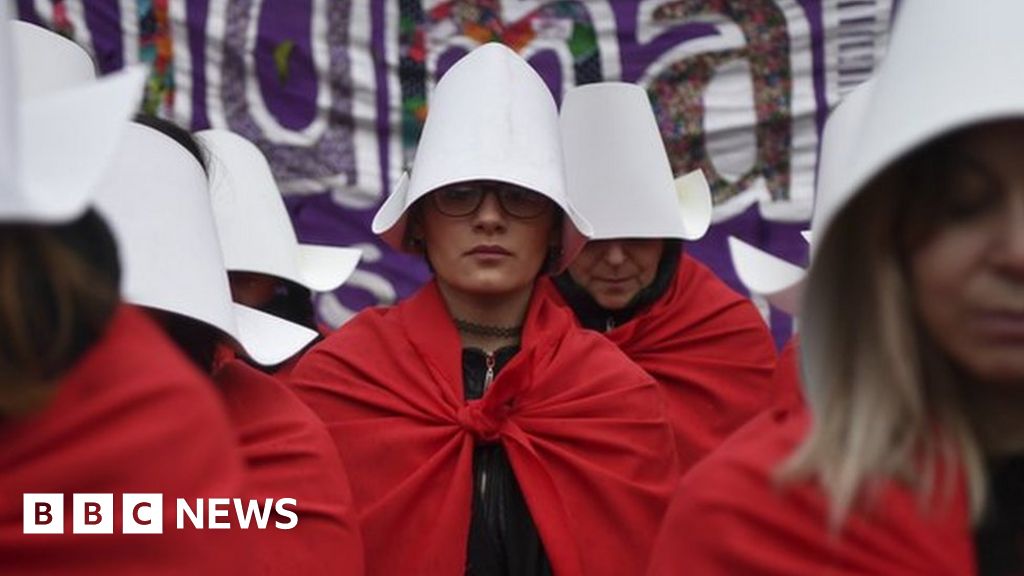
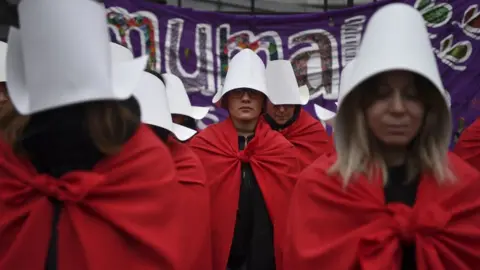
Dozens of women march in silence through a rainy cityscape. Heads bowed, dressed in red cloaks and white bonnets, it looks like a scene from Gilead, the theocratic patriarchy Margaret Atwood created in dystopian 1985 novel The Handmaid’s Tale.
But this is Buenos Aires. It is Wednesday, and the women involved are calling for abortion to be decriminalised in a country where complications arising from illegal abortion are a leading cause of maternal death.
“Nobody likes abortion, even when safe and legal,” the Canadian author had written.
“But nobody likes women bleeding to death on the bathroom floor from illegal abortions, either. What to do?”
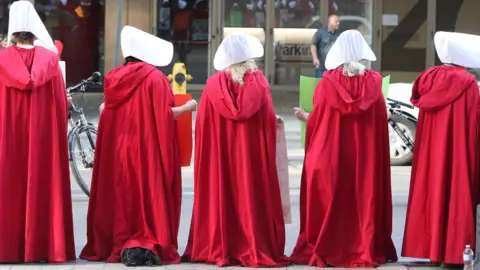
In many parts of the world, women’s-rights campaigners – particularly those concerned with reproductive rights and abortion – have embraced the symbolism of The Handmaid’s Tale. Language and iconography from the book and TV series are increasingly prevalent on marches, protests and social media.

 Getty Images
According to Amazon, Atwood’s 1985 novel was the most read in the US in 2017. Kindle and Audible sales data indicates it topped the charts in 48 of 50 states. That resurgent popularity is no doubt driven in no small part by the success of the Hulu television adaptation starring Elisabeth Moss, but activists also point to concerns about women’s rights following the inauguration of Donald Trump as president in January 2017.
Emboldened, anti-abortion activists hope Trump’s nomination of Brett Kavanaugh to the Supreme Court – which would ensure a conservative majority – could see a reversal of the landmark 1973 Roe v Wade decision which legalises abortion nationally.
“Donald Trump’s Supreme Court pick, Brett Kavanaugh, is an immediate threat to our hard-won fundamental rights and freedoms,” say the National Abortion and Reproductive Rights Action League (Naral) Pro-Choice America group, which campaigns for women’s reproductive rights and pro-choice legislation.
Allow Twitter content?
From March 2017, Naral activists in Texas intermittently dressed as handmaids to stage protests against anti-abortion legislation in the Texas State Capitol building, in what appears to be one of the first contemporary examples of handmaid protests to win global attention.
“This isn’t the first time Pro-Choice Texas used costumes,” Heather Busby, who was then executive director at NARAL Pro-Choice Texas, told The Verge last year.
“Back in 2015, we had folks in hospital gowns to protest [against] another abortion restriction. We had an inkling that this kind of thing is effective, and the timing of the show coming out, and with the book experiencing a resurgence in popularity, it seemed like the perfect convergence of all those things.”
Facebook groups and Twitter accounts documenting similar demonstrations were created, as handmaid protests went global.
Allow Twitter content?
 Isabel Marler
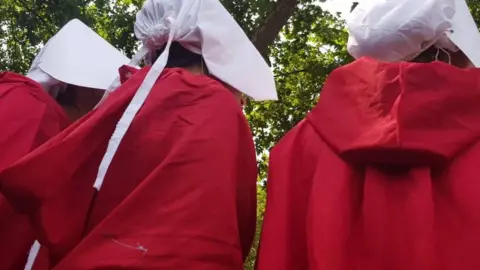
In London, Chiara Capraro, a women’s human-rights programme manager at Amnesty International, was among the crowds marching to voice their opposition to President Trump, who visited the UK earlier in July. She attended the protest with a friend, also dressed as a handmaid. Once there, they met other protesters in similar dress.
Speaking in a personal capacity, she told the BBC: “I read the book a long time ago.”
“I think that it feels less and less dystopian. Immediately when I heard there was going to be a protest I knew I would go as a handmaid.
“The symbolism is so powerful, reducing women to their reproductive functions. Women become just vehicles to produce children. It’s a symbol to say we need to be vigilant, to be careful.”
Ms Capraro was born in Italy, though she lives in London. Abortion in the first 90 days of pregnancy has been legal in her home country since a 1978 referendum. But medical professionals in the predominantly Catholic country can refuse to carry out the procedures on the basis of their religious convictions. Some 70% of gynaecologists in Italy refuse to perform abortions – a figure that has grown significantly over the past two decades.
“It’s not just a thing that’s happening in the US. It’s happening all over the world,” Ms Capraro said.
“It’s disheartening to have to take the same battles and fight attempts to oppress women. It’s a reminder that rights are not won for ever.
“People who are attacked under these agendas tend to be the most marginalised.
“But the feminist movement is finding strength again, if you look at what is happening in Poland and Argentina.”
In June, Argentina’s lower house narrowly backed a bill which would legalise elective abortion in the Catholic nation during the first 14 weeks of pregnancy.
The bill still needs to pass through Argentina’s senate, where it is expected to face an uphill battle. Several senators have expressed opposition.
If successful, Argentina will become just the third Latin American nation – after Uruguay and Cuba – to legalise elective abortion.
It is unlikely that activists will be putting away their cloaks and bonnets in the foreseeable future.
Leave a Reply