Features correspondent
 Netflix
The US TV programme mixed serious drama with a macabre sense of humour – and pioneered an influential kind of dark humour, writes Jennifer Armstrong.
The funeral home’s makeup artist has bad news for his bosses. Their niece is upstairs crying and won’t come down. The funeral home owners now have to decide between them who will go in and comfort her. “Oh, no, I think this one is yours,” David Fisher says to his brother Nate. Reluctantly, Nate agrees, but says he might end up punching her.
Instead, when he finds the tearful, blonde woman upstairs, he’s suddenly gentle, kind. She explains that her aunt was the only person who loved her; her husband didn’t, her parents didn’t. He meets her gaze when she asks, “Why do people have to die?”
He gives her the perfect answer, the one she needs: “To make life important.”
It is the final episode of the first season of HBO’s Six Feet Under, and no sequence could better sum up the series’ central theme – or its legacy. One minute, it’s funny – refreshingly cold and darkly humorous – and the next it’s deadly serious. Neither element would be as strong without the other: the humour would be too morbid without the occasional touching moment, and the touching moments would be too saccharine without the bite. Just as people have to die to make life important, people on Six Feet Under joke to make the serious moments matter. Death can be just as funny as life.


As Six Feet Under marks the 10th anniversary of its memorable finale on 21 August, we can see the show’s enduring legacy clearly. While it was one of several series that elevated television to new literary heights in the early 2000s, it brought something unique to the mix: dark humour. Before Six Feet Under, US TV in particular had been loath to address death in anything but the most serious terms. (The Mary Tyler Moore Show’s seminal 1975 episode Chuckles Bites the Dust, which hinged on Mary having a laughing fit at a clown’s funeral, was a TV landmark because it was so unusual.) But since Six Feet Under, death has become an occasion for laughing – for reveling in dark humour – as much as for crying on US TV comedies and dramas alike. It made it okay to laugh at death.
As the critic Sean Piccoli wrote when Six Feet Undersigned off in 2005, “Death as a hook could have made for oppressive viewing. But the genius of Six Feet Under was to recognise that life, as viewed from death’s perspective, is often a cruelly funny game. Death interrupts at the most inopportune moments, in the most inventive ways, in what amounts to existential slapstick at the expense of the living.”
When Six Feet Under premiered in 2001, its portrayal of a dysfunctional family tending to the funeral home they own following their patriarch’s death was an instant hit with critics. It dovetailed with the darkening mood of in the US – the 11 September attacks occurred later that year – and the programme went on to win nine Emmys, three Golden Globes and a Peabody Award.
 Netflix
From the beginning, it sought to occupy new television territory, apparently at the urging of executives at its network, HBO. Creator Alan Ball said in an interview with MovieWeb, “When I went to HBO and they had read my first draft… [HBO entertainment president] Carolyn Strauss said, ‘You know, this is really, really good. I love these characters, I love these situations, but it feels a little safe…. And I thought, ‘Wow!’ And that gave me free range to go a little deeper, go a little darker, go a little more complicated.”
HBO had good reason to push its new show, which would cement the network’s status as a leader in the dawning golden age of TV drama. Six Feet Under proved the cable channel’s success with The Sopranos was no fluke. It also sent a message that it was different from other shows: by the third episode, teenage character Claire (Lauren Ambrose) leaves a human foot in a boyfriend’s locker as revenge for blabbing about their sex life. It was clear that at a low point for actual comedies on US television, Six Feet Under was keeping humour alive: in one hilarious season three sequence, matriarch Ruth (Frances Conroy) and her friend (Kathy Bates) tie Ruth’s addict sister Sarah (Patricia Clarkson) to a bed to keep her away from the painkiller Vicodin, to which she has become addicted. In a death sequence in season four, devoted Christian Dorothy Sheedy (Beth Grant) mistakes inflatable sex dolls floating from a truck bed for angels heralding the rapture.
At a time when The West Wing, CSI, and 24 dominated drama, Six Feet Under felt undeniably fresh. At a time when Everybody Loves Raymond, Friends and Will & Grace reigned in comedy, it felt undeniably risky. Its success spawned similarly dark, sometimes even-more-twisted amalgams of comedy and tragedy: the plastic-surgery farce Nip/Tuck; Dexter, also starring Hall, about a serial killer with ‘good’ intentions; and Arrested Development, a family comedy that included Saddam Hussein and incest jokes.
Six Feet Under was not without its critics, but even they had to admit its influence. Addressing Ball on Slate in 2002, TV critic Emily Nussbaum wrote: “Damn your Emmy-Award-dominating, sex-solves-everything, madness-is-sanity, worst-of-JD-Salinger philosophies. And damn you, most of all, for ruining cocktail conversation. For if I had a penny for every time someone used your show as shorthand for quality television, I’d have a bunch of really annoying change.”
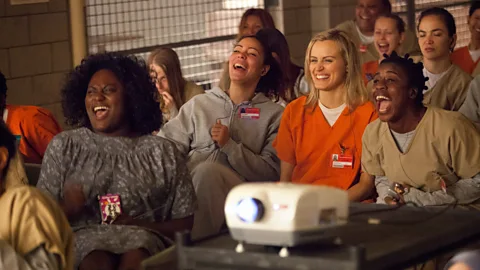
And yet, 13 years later, Six Feet Under’s influence is stamped all over our television sets and streaming devices of choice. Netflix’s The Unbreakable Kimmy Schmidtis a traditional sitcom about a cult-kidnapping survivor who may have been sexually abused. Orange Is the New Black is one of TV’s funniest comedies, despite being a drama about imprisoned women with often terrifying backstories, who have been raped by guards and, at times, have beaten each other to disturbing degrees.
 Netflix
Even the BBC’s Sherlock is a deft mix of the macabre and the whimsical unlike many Holmes adaptations before it. And Getting On – both the UK version and its US adaptation – tackles some very Six Feet Under-style themes as a sitcom set in a geriatric hospital ward. Then again, the British have never been shy about making shows that would make American audiences squirm.
Perhaps that’s why Six Feet Under got such a warm reception from British fans, including The Guardian’s Rosie Swash, who named it her favourite show in a column just last year. “It was the humour, the absurd arguments… that gave the series its undeniable warmth,” she wrote. “Even during the episode in season four in which David is kidnapped by a crack addict and forced to take drugs, before being beaten and doused in petrol, there are moments of hilarity. I sometimes wonder whether the writers’ central wish was to create a show that turned its audience into the kind of people who giggle during funerals.”
If so, they were successful. We’re still laughing 10 years later.
Leave a Reply