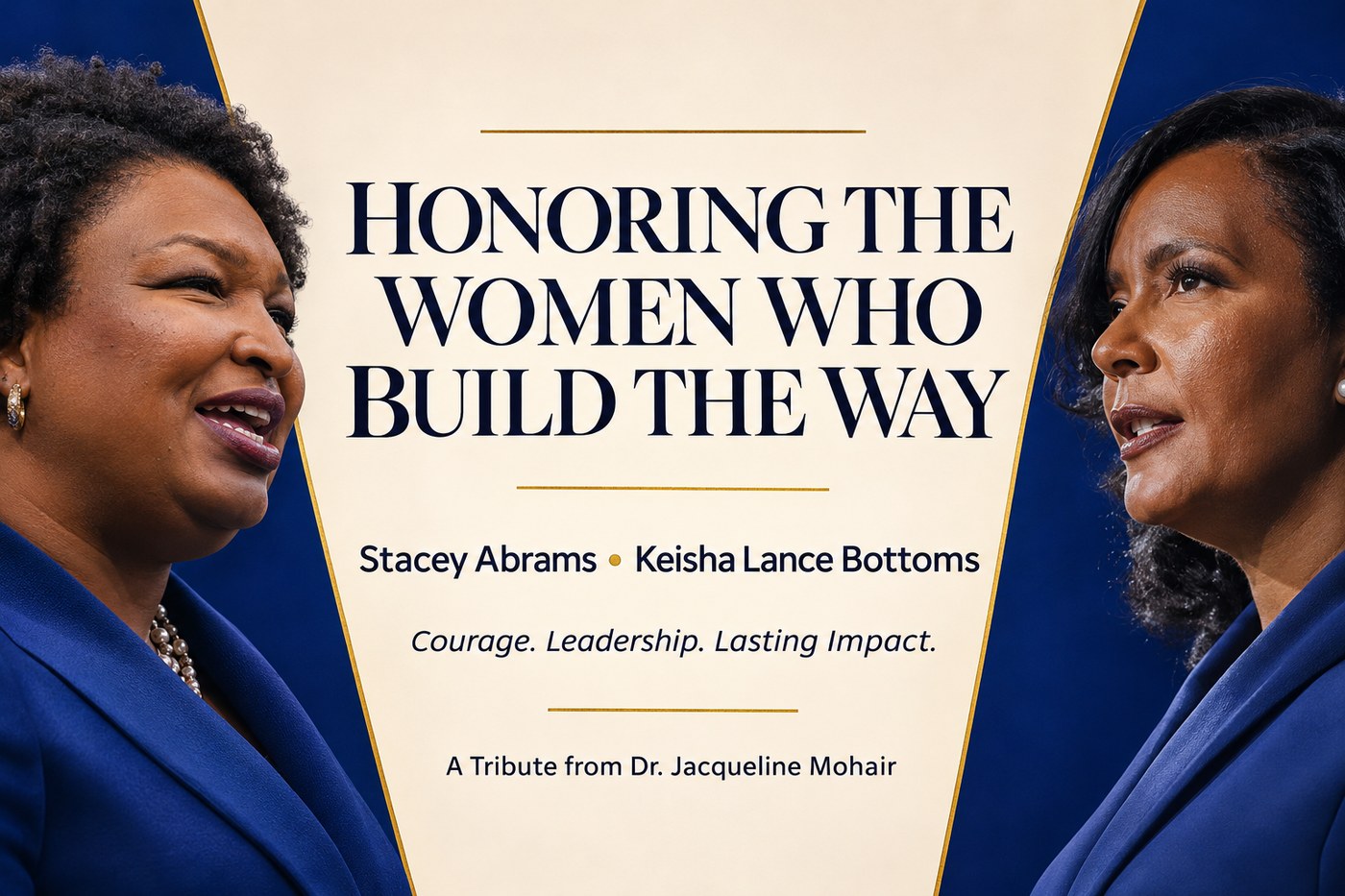
On the night of November 3, 2026, when Keisha Lance Bottoms was declared the next governor of Georgia, one of the first names spoken from the stage belonged to a woman who was not on the ballot. Stacey Abrams. For eight years, Abrams has been the architect of a political movement in Georgia that no one believed could be built. She ran for governor twice and lost twice. In losing, she changed who votes in Georgia, how they vote, and how many of them there are. The victory that arrived on Tuesday night was carried by the road she paved, and the woman who walked it to the end said so plainly.
Two Campaigns That Changed the Map
Abrams entered the 2018 governor’s race as a former House minority leader, the first woman to lead a party caucus in the Georgia General Assembly, a Spelman graduate, a Yale trained attorney, and an author. She left it as the most consequential losing candidate in modern Georgia history. She lost to Brian Kemp by about 55,000 votes out of nearly four million cast, a margin of less than two percentage points, in an election she and her supporters argued had been administered by her own opponent. Instead she founded Fair Fight. In 2022 she ran again and lost again. By then the coalition she assembled was specific and durable: Black women in Atlanta and Columbus and Albany, suburban women in Cobb and Gwinnett, young voters, Asian American and Latino families, and rural voters. She built organizations rather than moments.
The Woman Who Finished It
Keisha Lance Bottoms knew that coalition from the inside. As mayor of Atlanta from 2018 to 2022 she governed the city at the center of it. Her win, defeating Republican Rick Jackson by a margin that stunned analysts, made Bottoms the first Black woman elected governor in United States history and the first Democrat to win a Georgia governor’s race in more than two decades. It was also the completion of a circuit that Abrams had closed halfway, twice. Abrams campaigned for Bottoms and raised money for her, lending her the credibility of someone who had already been through the fire.
Paving the Way Is Work
Paving a way is not a metaphor for a single act. It is thousands of small acts, most of them invisible. It is a volunteer in a church basement checking whether a neighbor is registered, a lawsuit filed to keep a polling place open, or a grandmother told that her vote matters. Bottoms has been clear that her own victory is not a solitary achievement. She becomes governor because generations did the work of making her candidacy ordinary.
Two Women, One Instruction
The image that has circulated since election night shows the two of them in profile, facing each other, under a line that reads: the women who build the way. It is a fair description, and it is also an instruction. Georgia will have a Black woman governor in January, and a Black woman Secretary of State sworn in beside her. When the ballots are certified and the history is sorted, one name will sit at the front of the line of women who built the way. She did not win the election. She made it winnable.
Leave a Reply