 Getty Images
Human innards are teeming with viruses that infect bacteria. What are they up to?
You’ve probably heard of the microbiome – the hordes of bacteria and other tiny life forms that live in our guts. Well, it turns out those bacteria have viruses that exist in and around them – with important consequences for both them and us.
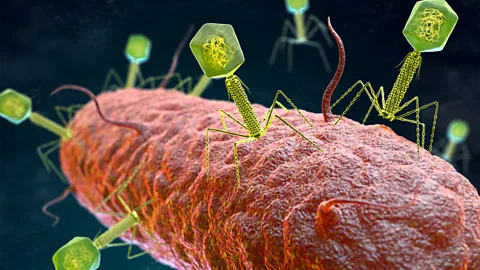
There are billions, perhaps even trillions of these viruses, known as bacteriophages (“bacteria eaters” in Greek) or just “phages” to their friends, inside the human digestive system. Phageome science has skyrocketed recently, says Breck Duerkop, a bacteriologist at the University of Colorado Anschutz School of Medicine, and researchers are struggling to come to grips with their enormous diversity. Researchers suspect that if physicians could harness or target the right phages, they might be able to improve human health.
“There will turn out to be good phages as well as bad phages,” says Paul Bollyky, an infectious disease physician and researcher at Stanford Medicine. But for now, it’s still not clear how many phages occupy the gut – perhaps one for each bacterial cell, or even fewer. There are also bacteria that contain phage genes but aren’t actively producing viruses – the bacteria are just living their lives with phage DNA tagging along in their genomes.
And there are lots of phages still unidentified. Scientists call these the “dark matter” of the phageome. A big part of current phage research is to identify these viruses and their host bacteria. The Gut Phage Database contains more than 140,000 phages, but that’s surely an underestimate. “Their variety is just extraordinary,” says Colin Hill, a microbiologist at University College Cork in Ireland.
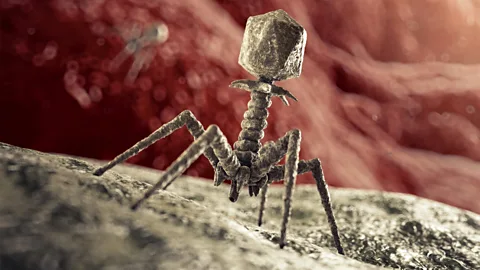
Scientists find phages by sifting through genetic sequences culled from human faecal samples. That’s where researchers found the most common gut phage group, called crAssphage. (named for the “cross-assembly” technique that plucked their genes out of the genetic mishmash.) In a recent study, Hill and colleagues detailed a light-bulb shape for crAssphages, with a 20-sided body and a stalk to inject DNA into host bacteria.
It’s not clear whether crAssphages make a difference to human health, but given that they infect one of the most common groups of gut bacteria, Bacteroides, Hill wouldn’t be surprised if they did. Other common groups, which also infect Bacteroides, include the Gubaphage (gut bacteroidales phage) and the LoVEphage (lots of viral genetic elements).
Though phages infect bacteria and sometimes kill them, the relationship is more complicated than that. “We used to think that phage and bacteria are fighting,” says Hill, “but now we know that they’re actually dancing; they’re partners.”
Phages can benefit bacteria by bringing in new genes. When a phage particle is assembling inside an infected bacterium, it can sometimes stuff bacterial genes into its protein shell along with its own genetic material. Later, it squirts those genes into a new host, and those accidentally transferred genes could be helpful, says Duerkop. They might provide resistance to antibiotics or the ability to digest a new substance.
Phages keep bacterial populations fit by constantly nipping at their heels, says Hill. Bacteroides bacteria can display up to a dozen types of sugary coats on their outer surfaces. Different coats have different advantages: to evade the immune system, say, or to occupy a different corner of the digestive system. But when crAssphages are around, Hill says, the Bacteroides must constantly change coats to evade the phages that recognise one coat or another. The result: at any given time, there are Bacteroides with different coat types present, enabling the population as a whole to occupy a variety of niches or handle new challenges.

 Getty Images
Phages also keep bacterial populations from getting out of hand. The gut is an ecosystem, like the woods, and phages are bacteria predators, like wolves are deer predators. The gut needs phages like the woods needs wolves. When those predator-prey relationships are altered, disease can result: researchers have observed phageome changes in inflammatory bowel syndrome (IBS), irritable bowel disease and colorectal cancer – the viral ecosystem of someone with IBS is often low in diversity, for example.
Perhaps we should be grateful for the trillions of phages managing the gut’s ecosystem. Without them, Hill suggests, a few kinds of bacteria might quickly come to dominate – potentially leaving you unable to digest some foods and subject to gas and bloating.
The wild and wondrous phageome is a dance partner for bacteria and humans alike.
* This article originally appeared in Knowable Magazine, and is republished under a Creative Commons licence.