 European Union/Copernicus Sentinel-2
Could warmer ocean temperatures be a sign climate change has progressed further than we thought?
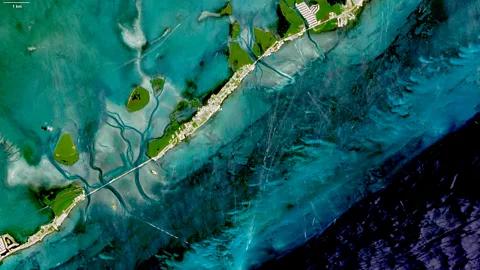
Florida seawater reaches “hot tub” levels
It is potentially the hotest seawater temperature ever recorded. Scientists have reported widespread coral bleaching in the area and are predicting that if the sea heatwave continues it could lead to the death of some reef residents.
One meteorologist compared the temperatures to being similar to those seen in a “hot tub”.
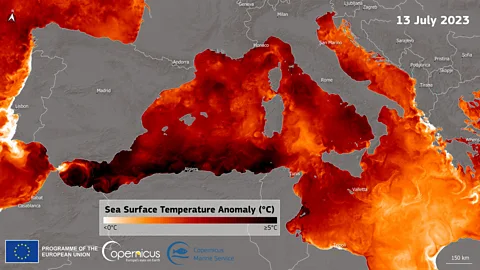
While the heatwave has since lessened in the north-east Atlantic, according to non-profit science organisation Mercator Ocean International, another in the western Mediterranean now appears to be intensifying, particularly around the Strait of Gibraltar. This week, sea surface temperatures along the coasts of Southern Spain and North Africa were 2-4C (3.6-7.2F) higher than they would normally be at this time of year, with some spots 5C (9F) above the long-term average.
“We are having these huge marine heatwaves in different areas of the ocean unexpectedly evolve very early in the year, very strong and over large areas,” says Karina von Schuckmann, an oceanographer at Mercator Ocean.

 European Union/Copernicus
Carlo Buontempo, director of the European Union’s Copernicus Climate Change Service, says scientists expect big temperature variations in the Pacific Ocean associated with the El Niño weather pattern, a phase of planet-warming weather which is just beginning, although NOAA is monitoring a large heatwave in the Gulf of Alaska that has been sitting offshore since late 2022. (Read more from BBC Future about what another El Niño will mean for you.)
But what we’re currently seeing in the North Atlantic is “truly unprecedented”, says Buontempo.
Scientists are still trying to unravel its full causes.
Short-term changes in regional atmospheric and ocean circulation patterns can provide the conditions for periods of intense heat in the sea lasting for weeks, months or even years.
But long-term increases in ocean temperature driven by an increase in greenhouse gas emissions are a key factor in recent heatwaves. About 90% of excess heat generated by anthropogenic climate change has been stored in the ocean, and the past two decades have seen a doubling in the rate of heat accumulating in the Earth’s climate system.
A 2021 expert report by the Intergovernmental Panel on Climate Change (IPCC) found marine heatwaves doubled in frequency between 1982 and 2016, and have become both more intense and longer since the 1980s.
Another potential contributing factor is the volume of aerosols in the atmosphere, which have a slight cooling effect but appear to have dropped as a result of a drive to clean up the shipping industry. More recently, there has been an unusual lack of dust blown from the Sahara, which also normally has a cooling impact.
The current marine heatwaves could even get worse. While experts do not think El Niño itself was a driver of the North Atlantic event, the WMO expects it to add fuel to wider ocean heating.
Experts are concerned because marine heatwaves can affect ocean life, fisheries and weather patterns.
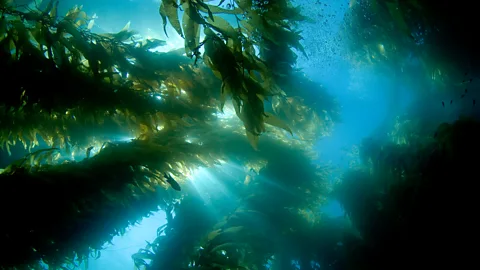
In the Mediterranean Sea, exceptional temperatures over the 2015-19 period led to repeated mass deaths of key species such as corals and seaweed. One recent study described marine heatwaves such as these as “pervasive stressors to marine ecosystems globally”.
However, there is still a lot to learn about the impact of marine heatwaves compared with those on land because monitoring is more difficult and there is a lack of long-term records, says Smale. “The data we get from satellites since the early 1980s has been amazing… but the problem is trying to then go deeper,” he says.
 Getty Images
A significant drop in phytoplankton has already been seen in the western North Atlantic, which Mercator Ocean attributes to the recent heatwave. This spring bloom is crucial because it provides most of the energy needed to sustain the region’s marine food chain and makes a substantial contribution to global ocean CO2 uptake.
The economics of regional fisheries could be affected too. A 2012 heatwave over the north-west Atlantic led marine species that favour warm water to move northwards and migrate earlier, changing when and how much seafood could be caught.
The North Atlantic is also a key driver of extreme weather. High sea surface temperatures can fuel hurricanes, although whether the developing El Niño will exacerbate or dampen this effect over the next year remains to be seen. Further inland, the warmth of the North Atlantic is the most important factor behind the alternating cycle of drought and heavy rain in central Africa.
More broadly, experts say the persistence of recent marine heatwaves is a worrying sign about how climate change is unfolding, alongside heatwaves on land, unusual melting of snow cover in the Himalayas and a loss of sea ice. Von Schuckmann notes that, even if humans stopped pumping CO2 into the air tomorrow, the oceans would continue to warm up for many years yet. “I am concerned as a climate scientist that we are further than we thought we are.”
* This article was first published on 21 July 2023, but was updated to include the latest data from the end of the month and the first week of August.