 EPA
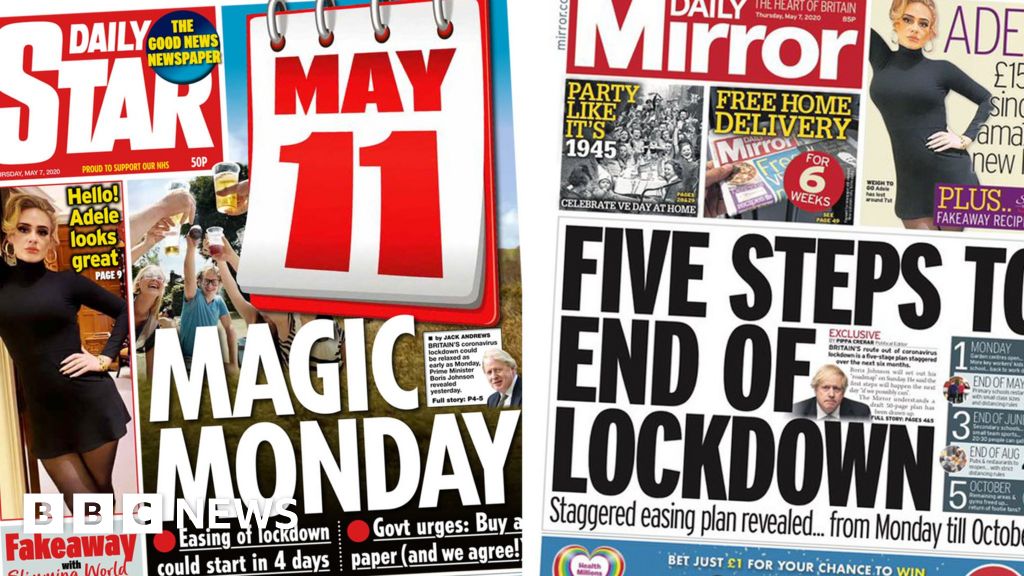
EPAThe majority of Thursday’s papers are focused on the prospect of some possible changes to the lockdown.
It is not the only front page to do so. The Daily Mail proclaims “Hurrah! Lockdown freedom beckons”, while the Daily Express goes for: “First steps to freedom”.
There is a lot of speculation about what measures are likely to be relaxed and when. The Guardian suggests that straight away people will be allowed to sunbathe, have picnics and go rambling.
It predicts that primary school classes will resume at the end of this month, secondary schools in June, and pubs and restaurants will reopen in August but with social distancing.
One possibility it mentions would be a 14-day quarantine period for all arrivals from abroad, including British citizens.
The Times suggests the slogan – which has been the core message of ministers since the end of March – will be replaced by one which urges people to “stay safe, save lives”.
In its leader, the Telegraph argues that Boris Johnson may face a challenge in changing the public’s mindset. It believes that if the prime minister is over-cautious about the message, “he risks losing the power to persuade people that it’s safe to surface”.
But it does point out that trust in him and his government is “high”.
Johnson vs Starmer
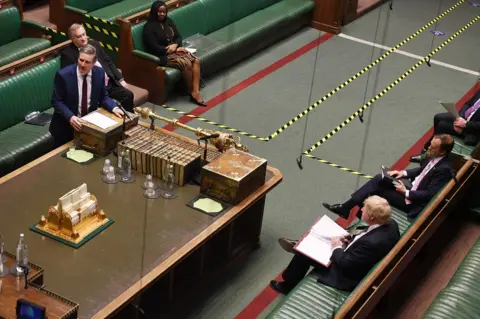
Several papers consider the performances of Boris Johnson and Sir Keir Starmer, in their first encounter at Prime Minister’s Questions.
For the Daily Mirror, it was round one to the new Labour leader. “With six piercing questions,” says its leader column, Sir Keir “punctured Boris Johnson’s claim that the government’s handling of the coronavirus crisis had been a success”.
Henry Deedes – the Daily Mail’s sketch writer – believes the exchanges over the dispatch box had a whiff of James Bond about them.
“Early in each story,” he writes, “comes an inaugural meeting between hero and foe. A chance encounter over highballs, perhaps, or a high-stakes hand of chemin de fer.”
Wednesday’s session had a “slight flavour of this”, he suggests, concluding that it was “less a head-to-head confrontation than a peek into the milky whites of each other’s eyes”.

 EPA/Jessica Taylor/UK Parliament
“The relatively gentle initiation did not stop his hands shaking,” it reports. But it also points out that the prime minister – who was “denied the army of Tory MPs who would usually cheer at his soundbites” – was relatively subdued.
According to the Guardian, Sir Keir struck the right balance, managing “to assert the truth about government failings, without appearing to undermine its pandemic response with excessive partisanship”.
But it believes he has a long way to go. “No-one expects to see a fully-formed government in waiting yet,” it says. “But there will come a time when voter demand to know what the opposition stands for, besides criticising the Tories”.
Coronavirus app
The Financial Times suggests the new NHS app, to trace people who’ve been exposed to Covid-19, is “in question” – just days after it was launched.
The paper claims it’s seen documents that show a Swiss IT firm has been awarded a contract – worth £3.8m – to investigate switching to Apple and Google’s contract-tracing technology, which does not store information centrally.
The FT points out that this would be a U-turn from the UK’s original decision to reject help from the tech firms.


“Cornwall facing £885m summer season wipe-out” is a headline in the Daily Express.
It quotes the county’s head of tourism, Malcolm Bell, urging the government to allow the sector to reopen before the end of the summer.
Mr Bell says a balance must be struck between protecting customers and protecting the communities of Cornwall.
He warns that if visitors are not allowed back until September, there’ll be “massive implications” for thousands of business owners and staff.
And several of the front pages, including the Daily Express and the Times, feature photos of the singer Adele who has published an Instagram post supporting essential workers.
Like others, the Times draws attention to her appearance, saying she has thought to have lost seven stone using an exercise regime.
She reminds readers that: “As a society, we are supposed to have progressed beyond noticing what a woman weighs.”
Leave a Reply