 Serenity Strull/BBC/Getty Images
Olympic sprinters have won the genetic lottery, but that does not mean that the rest of us cannot learn to run faster.
Every four years the Olympics and Paralympics give us a chance to see just what the human body is really capable of. Athletes at the peak of their abilities perform feats most of us can only dream of.
And perhaps the most enthralling of all is the contest when the fastest people alive step onto the track. In few other sports is there such a clear side-by-side comparison of performance.
“The thing about sprints is, you’ve got your own lane,” says Eilidh Doyle, who specialised in the 400m sprint and hurdles, and won bronze for Great Britain in the 4 x 400m relay at the Rio 2016 Olympics. “It’s not like the 1500m where people’s tactics can directly influence you. You pretty much stand at the start lane and say, ‘I know what the plan is, and I’m going to execute that plan, because nobody else can mess with that’.”
“You either take longer steps or you take faster steps. That’s the most basic thing you can do,” says Sam Gleadhill, who is a biomechanics and strength and conditioning researcher at the University of South Australia. “The caveat to that though, is that if you improve one of those variables, you don’t want to decrease the other.”

 Serenity Strull/BBC/Getty Images
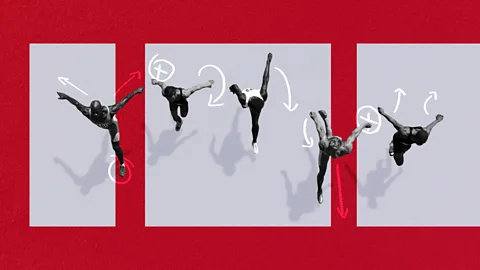
“Even in the 100m final of an Olympics, there’ll be different techniques between the runners,” says Gleadhill. “Guys like Christian Coleman, who are really strong and quite muscular, they explode out of the block. They accelerate for a long time, stay really low to the track, and they have shorter steps. Whereas guys like [Usain] Bolt are taller or have a little bit more leg length, so they are taking longer steps.”
Compared to non-sprinters, sprinters have larger hip and knee flexor muscles. In a study of five elite male sprinters, the tensor fasciae latae, sartorius and gluteus maximus (all muscles in the hip area) were consistently larger than in 11 sub-elite male sprinters. The same team of researchers found that larger hip flexors explained a 47.5% variance in the sprint performance of five elite female sprinters compared to 17 sub-elite sprinters.
Step frequency, on the other hand, is determined by motor neuron excitability, inter-and intramuscular coordination, and neural fatigue. Athletes reliant on step frequency need high neural activity just before sprinting to achieve a quick leg turnover.
 Serenity Strull/BBC/Getty Images
There is some question, however, as to how much step frequency can be improved.
“In my point of view, you have to depend more on improving the step length,” says Vassilos Panoutsakopoulos, an assistant professor of biomechanics at Aristotle University of Thessaloniki in Greece. “The step frequency is something that, after you mature, does not change.”
Sprint performance is influenced by both genetic and environmental factors. But genetics may play a larger role in step frequency because it is related to motor neurone excitability. People who tend naturally to walk fast may be better sprinters too.
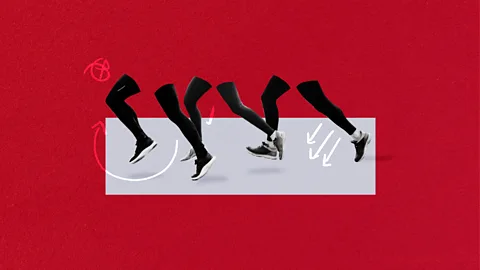
“The most important thing that we found is that children don’t have the ‘pawing’ action,” says Panoutsakopoulos. “Young sprinters just place the foot.”
Panoutsakopoulos likens the correct action to pawing the ground like a horse, with flexion in the foot, rather than flatfooted like a duck.
“You can see that when Olympic sprinters come out of the blocks with their shin angles being as horizontal as possible or facing along the track,” says Gleadhill. “At top speed, the vertical force becomes much more prevalent.”
Sprinting frequently is the simplest and best way to increase speed. But there are drills to isolate movements and improve technique:
“There’s high knees, which I think a lot of people do wrong,” says Doyle, “When you run, you don’t lift your knees up out front. Your heel comes to your bum, and by your heel doing that your knee goes out anyway.”
Perfecting efficient sprinting technique takes years of training in coordination, stabilisation, nervous system activation and muscle usage. But there are small tweaks everyone can try such as flexing the foot more, leaning forwards during acceleration, or focusing on touching the ground for as short a time as possible.
Everyone is individual, with different leg lengths and neuromuscular makeup, so it is worth experimenting with which style makes you sprint fastest.
If you liked this story, sign up for The Essential List newsletter – a handpicked selection of features, videos and can’t-miss news, delivered to your inbox twice a week.
For more science, technology, environment and health stories from the BBC, follow us on Facebookand X.