 PA Media
Some sectors of NI’s economy are set to reopen within days after closing down at the start of the coronavirus outbreak in March.
Resuming trade in this new normal brings many challenges and unknowns.
BBC News NI looks at the guidance given to these sectors and whether it goes far enough for businesses and customers.
General advice
The first thing to note is that in May, Stormont’s Department for the Economy issued guidance for all workplaces regarding safety measures – it’s here.
It provides broad advice relating to social distancing, stressing that floor markings should be used and, where social distancing isn’t possible, screens and barriers should be in place.
The document also repeats the importance of facilities to wash and sanitise hands.
It also says it is for employers to provide personal protective equipment (PPE), where it is required by risk assessments carried out by individual firms.
But, unlike in England, businesses are not being asked to keep a temporary record of customers and visitors for 21 days to support the test and trace system.
The advice also does not get into practicalities and says it is intended to be “universal”, as opposed to replacing industry-specific guidance.
So what’s the industry-specific guidance?
That depends on which industry you are looking at.
On Tuesday, the department issued guidance for the tourism and hospitality sectors that set out advice about changing seating, staggering arrivals and encouraging the use of outdoor areas.
Customers will also be urged to order online or through apps where possible.
But what will it be like going to restaurants or pubs?
We have a rough idea, but it’s not clear cut because every establishment is different.
Restaurants and pubs that serve food can provide alcohol, but pubs that don’t serve food can only sell alcohol outdoors.
There is no defined limit on the number of people who can go to a pub or restaurant together, but it is up to individual businesses to monitor this.
Hospitality Ulster has said that “bookings for large groups should be avoided without additional information”, but it’s not advised to ask customers if they are from the same household.

 PA Media
Social distancing being reduced to 1m (3ft) from 29 June will make it easier for some establishments to seat people from different households closer to each other.
There is also no time limit on how long people can stay, although it’s advised customers should be ordering at least a main course, as well as any drinks they want to purchase, in restaurants and pubs that serve food.
Colin Neill, from Hospitality Ulster, said businesses would have to learn by trial and error after reopening begins, but stressed that customers would need to play their part too.
When customers arrive somewhere, they should be briefed by a member of staff and abide by the guidelines in place, he added.
What else will change?
Hospitality businesses have been advised to avoid playing any live music or live sports, which may “encourage people to relax their social distancing”.
There will not be place settings or cutlery laid out in the way you might have been used to, with businesses urged to set these out at the time of customers being provided with meals.
Queuing up to order drinks also won’t be allowed, with businesses advised that table service must be in place.
Many hospitality businesses have been working over the past few months to get themselves ready to reopen under these guidelines, but there is no one-size-fits-all and the advice remains open to interpretation.
What about the hair and beauty sectors?
They have not received any further details from Stormont, other than the general advice issued to all workplaces.
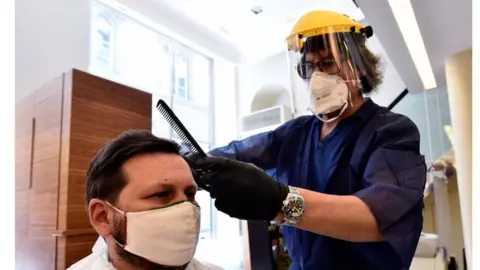
Hairdressers, barbers and beauticians have been working for months to get their businesses ready to reopen, in line with social-distancing measures.
Some have spent a lot of money buying PPE for both their staff and customers.
 Reuters
The Hair Council in England recommends all PPE is single use where possible.
It also says magazines should also be removed from all premises.
But it is essentially up to each salon in Northern Ireland to carry out its own risk assessment and determine what it’s able to do safely.
Can any of this be enforced?
The Department for the Economy said its guidance is advisory and does not require enforcement.
“Enforcement of professional trade bodies’ guidance is a matter for the bodies themselves,” a spokesperson said.
They added that town centre businesses and services, such as hair and beauty, fall under the remit of local councils for health and safety inspection and enforcement.
While there is relief that these sectors are now reopening, the bulk of responsibility has been shifted onto businesses and customers.
Ultimately, that could prove difficult to manage.