 Getty Images
For centuries we have used glass to store food, beverages, chemicals and cosmetics. But is it time to find a more sustainable alternative?
The widespread use of glass as a storage vessel throughout history highlights the material’s resilience and functionality. Glass is a useful material for everything from preserving food to carrying the signals that power the internet. So essential is glass to human development that the United Nations named 2022 the International Year of Glass to celebrate its contribution to cultural and scientific development.
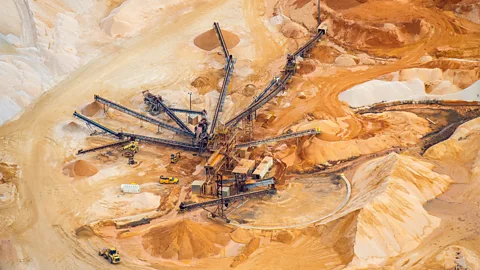
When glass is left in the natural environment, it is less likely to cause pollution than plastic. Unlike plastics, which break down into microplastics that can leach into our soils and water, glass is non-toxic. “Glass is mainly made of silica, which is a natural substance,” says Franziska Trautmann, the co-founder of Glass Half Full, a New Orleans-based company that recycles glass into sand that can be used for coastal restoration and disaster relief. Silica, also known as silica dioxide, makes up 59% of the Earth’s crust. Since it is a natural compound, there is no concern about leaching or environmental degradation.

 Edwin Remsburg / Getty Images
Because of this, glass is often touted as a more sustainable alternative to plastic.
Glass requires higher temperatures than plastic and aluminum to melt and form, says Alice Brock, a PhD researcher at University of Southampton in the UK. Raw materials for making virgin glass also release greenhouse gases during the melting process, adding to its environmental footprint. According to the International Energy Agency, the container and flat-glass industries emit over 60 megatonnes of CO2 per year. It may seem surprising, but Brock’s study found that plastic bottles are less environmentally damaging than glass bottles. Although plastic cannot be endlessly recycled, the manufacturing process is less energy-intensive, as there is a lower melting point for plastics compared with glass.
The raw materials for glass are melted together in a furnace at 1500C (2732F). The molten glass is then removed from the furnace, shaped and moulded. Glass production facilities often add a portion of recycled glass cullets into the raw material mix. Generally, a 10% increase in glass cullet into the container glass melting mixture can decrease energy consumption by 2-3%. This is because it requires a lower melting point to melt glass cullet compared to the virgin materials used to produce glass. In turn, this slightly reduces the CO2 emissions produced during manufacturing.
 Remko de Waal / Getty Images
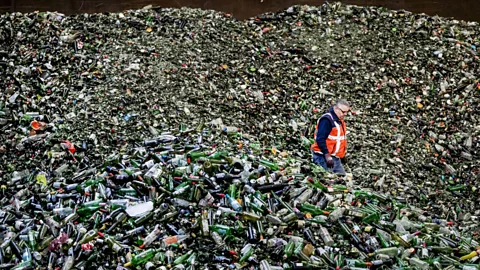
Recycled glass must be first be crushed into cullets before being melted into a new product – which is partly why recycled glass might only be fractionally less energy-intensive than virgin glass.
There is no doubt that glass still plays an important role in many industries. Its durability and non-toxic properties make it ideal for foods and materials which require preserving. However, the assumption that glass is sustainable merely because it is infinitely recyclable is misconstrued. Considering its entire lifecycle, glass production may be equally as detrimental to the environment as plastic.
The next time you want to discard a glass bottle, perhaps consider reusing it first. Glass is a resilient, long-lasting material that is not made to be thrown away after only being used once.
* This article was updated on 16 May 2023 to correct an error that stated recycled glass was melted into cullets before being melted again into products. It is crushed into cullets rather than melted.